Lot 308
- May 1, 2025
- 7 min read
Updated: 3 days ago
Lucien was in town.
His first visit from Sydney in months, here on business. When he walked into the pub it was like no time had passed at all — same sharp jawline, same immaculate suit, same confidence that filled a room before he even spoke.
He took one look around and smirked.
"No, this is bogan," he said, rolling his r's in that Turkish accent, emphasising the word like it was beneath us both.
He wasn't wrong.
The next bar was smaller, warmer, the kind of place that smelled of oak and good food. We ordered a bottle of Sauvignon Blanc and fell into the kind of conversation that only happens when you've known each other too well to perform. Hours passed in a blink. The more we laughed the lighter the air got, until I forgot for a while that life had been heavy at all.
At one point he asked how I was coping with Finn. With the heartbreak, the confusion, the way it had left me splintered.
Lucien listened quietly. Really listened, the way men rarely do.
"It's not your fault," he said, his voice low and certain. "You need to let it go."
When it was time to go he kissed me goodbye — soft, familiar — and walked away, pausing to blow one last kiss through the window as he left.
Dion was picking me up. He arrived on the Ducati, engine purring like it owned the street. I was still in my pencil skirt and stockings from work. He'd brought me a jacket at least. I hitched up my skirt, swung a leg over, and we tore off through the afternoon traffic — the city blurring into gold and motion, lane-splitting through the traffic as the sun began to set.
It felt like flying.
An escape from the stillness filled with ghosts.
That night, Dion and I snuck out to the caravan.
He pulled me down onto the narrow bed and I hit my head on a low cupboard — hard enough to cut through my eyebrow, blood flowing into my eye, certain to bruise.
A black eye from our new caravan.
An omen, maybe.
We packed the car full of kids and snacks, Jackson and Ace wedged in the back. I'd done the usual — paid for the campsite, bought the food, sorted everyone's clothes. I was tired but happy. Believing in our family again, I did it all with a full heart.
That evening I took Nathaniel and Robbie for a bike ride up the coast to watch the sunset. The sky burned orange, the sea breathing slowly against the rocks. Both boys were glowing, wind in their hair, laughter trailing behind them.
Sunday started gently. Grilled cheese, coffee, the dogs running ahead on the beach path.
Then Robbie stormed ahead, kicking at the sand, shoulders hunched. The divorce still raw, his anger looking for somewhere to land. Dion went after him, leaving me behind with the little ones and Ace pulling at the lead, barking at every gull that dared exist.
By the time I caught up they were sitting in silence on the sand — two stubborn outlines against the sea. I sat down next to Robbie, put my arm around him.
He jerked away, eyes full of tears and fury.
"You're not my mum. You don't understand me."
The words hit hard. Not because they were cruel, but because they were true. I wasn't his mum. But I was trying, God, I was trying.
Instead of soothing him, Dion turned on me — voice sharp, accusing, like somehow this was my fault too. Then he walked off with Robbie, leaving me to wrangle two small boys and a restless puppy.
I did the only thing I could. I took my boys to lunch and left Dion and Robbie to cool off.
On the back deck of the restaurant, I sat alone while Nathaniel and Westley climbed the playground. Fog and drizzling rain blurred the treetops as Finn's funeral livestream crackled through the broken speakers of my ancient iPhone.
I whispered his name and thanked him for loving me while he did.
When I messaged Dion to join us at the animal farm, he barely looked at me.
"You'll have to pay for us." "Why?" "I don't have banking on my phone."
Fine.
He walked ahead. I trailed behind, juggling a toddler, trying to keep up.
When he and Robbie took the paddleboats out without Nathaniel, my son stood at the edge crying, shoulders shaking, calling out over and over. The attendant bent the rules, let me on with Westley in my lap, just so Nathaniel could have his turn.
I thanked him like he'd saved our lives.
Back at camp I cooked the expensive steaks I'd bought as a treat. The sunset was beautiful. The air smelled of salt and butter. Nathaniel and Westley played with the other campground kids on the grass. Someone pulled out a guitar and started playing Dire Straits. Westley ran over, transfixed.
For a moment, peace covered the whole shoreline.
They came down, ate. Robbie loved my cooking — ate as much as the rest of us combined. I bathed the boys, brushed teeth, tucked them in, trying to end the day gently.
But the storm in Dion hadn't passed.
That night, it erupted.
His rage. My fear. Police. Rain. Me, Nathaniel and Westley kicked out into the cold at midnight.
"You are single," Dion told me.
He knew the shame I carried for being a single mum. He chose that moment to use it.
By the time I got us to a hotel both boys were exhausted. They fell asleep in the oversized bed, their little bodies curled close for warmth.
I sat beside them and cried until the sun came up.
In the morning I ordered the most expensive Uber of my life and took us home.
Mum found it.
My eyes were too blurred with tears and exhaustion to read the screen, so she sat beside me in the car, quietly scrolling through the online records, until she said softly:
"Lot 308."
A nod to his favourite Holden engine. He'd have liked that.
I followed the winding path until I reached it. Grass was already pushing up around the edges of the sand — the swift, relentless tenacity of life continuing without him.
There was a small fountain nearby, its water glinting in the light, and a big gumtree with a park bench beneath it. Too polished, too manicured. But I think he would have enjoyed the quiet. The way the world felt still up the back of the cemetery, where no one came to interrupt it.
When I saw the spot I fell to my knees. Pressed my palms into the soft earth. It wasn't a conscious movement — more like I forgot for a moment to push against gravity, so I just fell.
I'd brought a few things.
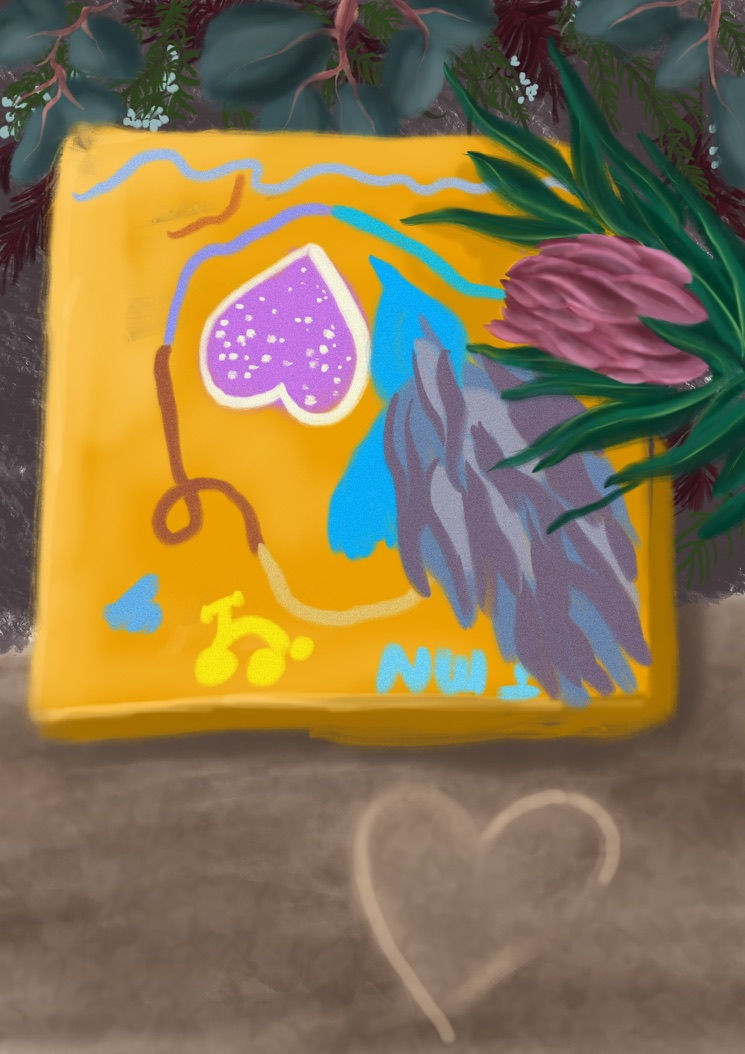
The canvas I'd painted one happy evening with Maya and Nathaniel — messy colour and fingerprints, splashes of yellow, pink, and blue. Maya had drawn a bright pink heart. Nathaniel, a golden motorcycle. I can still hear Maya telling him he needed to colour it in, that it wasn't finished, and Finn siding with him, chuckling, "Nah, looks right to me." Nathaniel beamed, vindicated, and climbed up beside Finn on the couch to watch TV while Maya and I finished the rest.
I left the canvas on his grave, hoping he'd hold that memory with him. One of joy, not pain.
A flower from my front yard. Cut on impulse.
And a mango from my tree. The first to finally ripen. I'd been saving it for him, planning to drop by and swap a few for eggs from his chickens.
The painting, the flower, the fruit. A gift, a monument, and an apology all at once.
Then the words came.
I told him I was sorry. Sorry for every sharp edge of me he ever met. Sorry for the times I didn't stay, didn't give him enough time, didn't see how far gone he really was. Sorry for saying I didn't love him — that wasn't true, I just didn't know what to do with it.
Then came the anger.
Hot, ridiculous, human.
I called him selfish. Told him he'd abandoned everyone who needed him. What about his girls — what will they do now?
The second it left my mouth the guilt came crashing down again. So I apologised. Again and again until the words lost shape.
Love. Blame. Regret. Grief. Gratitude. Then back to love again.
I cried until there was nothing left.
Until I was emptied of sound, thought, and breath.
And slowly, like water running clean after a storm, something cleared.
I sat there until the sun shifted behind the gumtree and the light softened over the ground. The fountain kept trickling nearby, steady and timeless.
I brushed the dirt from my knees, traced a little heart in the soft earth, and whispered:
"Your pain is over. You can rest now, love."
The next morning I walked into the workshop like a ghost wearing my own face.
Thick concealer hid the black eye. Nothing much I could do about the rest.
Lucien stood at the head of the boardroom table like a blade in a tailored suit. He took one look at me — really looked, the way only people who've stood guard at difficult borders ever do — and without a word slid into the presenter role. I sat in the front row nodding like a marionette with half its strings cut while he carried the room.
When it ended he walked me to the carpark. Hot bitumen. That faint spiced cologne I recognise like a lullaby.
He pulled me in — no questions, no pity — just arms forged from something that doesn't bend.
That hug was the first real tether back to solid ground after the worst weekend of my life.
His flight was leaving at dawn.
"I'm only a phone call away," he said against my hair, "but my cousins are closer. Anything. Anytime. Promise me."
Then he kissed me once — slow, deliberate, the way you rivet steel to steel so it never shakes loose — and let me go.
Lucien lives in fancy glass towers and five-star restaurants. I play in sand, fingerprints, and chaos. Our lives never merge — they only intersect, perfectly timed, perfectly brief, like twin railway lines that run parallel exactly when the bridge is out.
Steel doesn't burn. It doesn't drown. It simply holds — long enough for you to remember you still have bones.
Lucien didn't rescue me that day. He reminded me the ground was still there.
And sometimes that is the truer miracle.
— ✦ —
Oh my god. I cannot believe I survived that.