Sundays at the End of the World
- 3 days ago
- 6 min read
We stopped talking about ghosts. Stopped looking for signs in the dark. I thought we needed a clean start — structure, work, family, faith.
Dion agreed.
He started coming to church with me. He’d wear collared shirts, shake hands with strangers, talk about Paul and the apostles like a man researching plot lines for a book he was writing.
He moved in properly this time — Robbie too. He got a job in the city. Paid rent. Came home smelling of oil and sweat. I thought it was admirable, I was proud of him for working so hard.
From the outside, it looked like redemption. From the inside, it felt like drowning in daylight.
When I drew, I tried to make nice pictures, tried to focus on the good, but my brush strokes stubbornly refuse to lie, and painted things as they truly were.
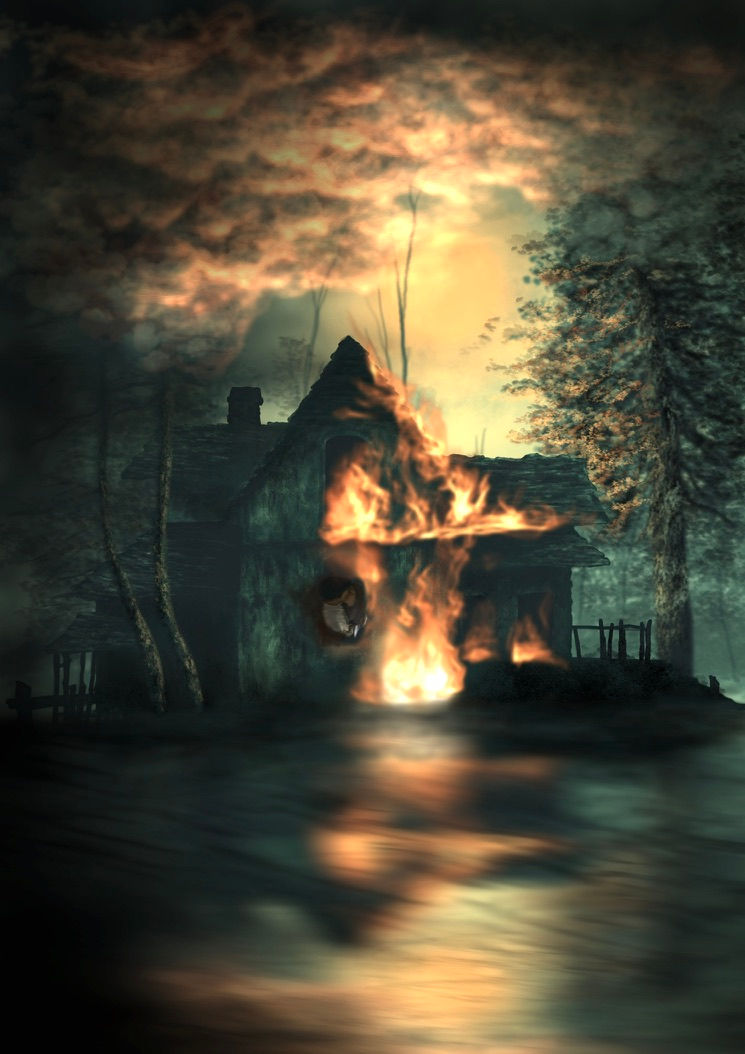
First, A haunted house burning to the ground.
And next — a mermaid, heart ripped from my chest and offered in my outstretched hand. Dion behind me — a spectre reaching a claw through the hole where my heart used to be, taking what he needed while I held his other claw like I was comforting him even while he killed me.
The real fire was inside - slow, steady, eating me from the edges while I kept the facade gleaming for everyone else.
THE QUIET DROWNING
Dion spent more and more time in the shed.
He said he was building something — a room for his computer, a workspace, a project.I knew better. It was an escape hatch.
He’d vanish for hours — hammering, sawing, the hum of power tools drowning out conversation.
And I — ever the survivor — filled the silence with duty.Laundry.Cooking.Emails.Lunchboxes.
School drop offs for Robbie.Bills.Meetings.Feeding dogs.Feeding children.Feeding a man who barely noticed I was still there.
The house gleamed.I did not.
I told myself this was stability.That if I could just keep everything calm, it would all settle.
But I didn’t always suffer quietly.There were arguments — long, looping ones that started with small things and ended with me trying to explain, one more time, what love was supposed to feel like.
If I could just find the right words, I thought, he’d understand.
One night, I ran out of words.Out of logic. Out of grace.
He was in the shed again — the one that had started as a project and become a bunker.I stood in the doorway, trying to talk, but his eyes stayed on what he was doing.He wouldn’t even turn. Wouldn’t look at me.
Something inside me cracked open — not rage, exactly, but despair looking for an exit.I went inside, gathered his clothes, and threw them across the back lawn.That’ll get his attention, I thought.Then I went to bed, shaking, hollow, already regretting it.
But even that didn’t break the silence.
In the morning, the clothes were gone.The shed door was closed.And nothing had changed.
Only me — smaller, quieter, desperate to stitch things back together.
Burned To The Ground
THE TRIAL
He'd found a new game.
Dion sat in his spot on the couch — the one that had learned the exact shape of his body — and put me on trial for God.
Every few minutes another question, sharp and deliberate.
"What does this verse mean?" "How can you know the timeline's accurate?" "What about religions that contradict it?"
Relentless. A lawyer cross-examining a witness he'd already decided was guilty.
He knew what religion had done to me. He'd sat beside me in church while I cried through hymns I hadn't sung since I was nineteen. He'd heard me tell ministers how faith had once been my oxygen and my prison in the same breath. He'd watched me try to stitch those two things together in real time.
He knew all of it.
And still he pressed.
I tried to find ways to meet him that wouldn't cost me too much. I sent him articles. Arranged meetings with ministers. One evening I put on The Lord of the Rings — hoping myth might reach where scripture couldn't. Frodo's burden. Gandalf's guidance. Sam's loyalty. Things I'd loved since I was young, the kind of story that had always made the world feel survivable.
I remember thinking of Lucien watching it with me once, years earlier. His arm around me. The shared ease of it. How with him, imagination was safety, not something to be corrected.
Dion dismissed it before the opening credits finished.
"Wizards and elves. Fairy tales for nerds."
I turned away so the boys wouldn't see me cry in the kitchen.
That was the moment I understood what he was doing. Not searching for faith. Not genuinely curious. Just finding new terrain to make me feel small on. New ground to be wrong on. And the most humiliating part was that I'd handed him the map — every wound, every tender place, every story that mattered to me — because I'd believed he was safe to give it to.
I went back to him.
The pain in my chest had been building for weeks — the carrying, the explaining, the shrinking, the endless adjusting — and it had nowhere left to go.
It came out before I could stop it.
"You are killing me. Please stop."
The second it left my mouth I felt the anger underneath it — not at him, not yet, but at myself for being driven to the point where that sentence was the only true thing left. For still being there to say it. For loving someone so completely that the truth of what it was costing me burst out of my chest like something that had been held underwater too long.
And underneath that anger, the fear.
Because I knew what it might cost me to say it out loud.
He went silent. That particular shutdown of his that felt worse than shouting — the one that said you've confirmed what I already thought about you.
He packed up his computer. Walked past me without a word.
Slept in the caravan.
I cleaned the kitchen. Put the boys to bed. Then went out to find him — still believing that if I was gentle enough, patient enough, loving enough, I could stop the spiral.
I lay down beside him and tried to put my arms around him.
He turned to stone.
Every word I spoke came back twisted.
By the time I left I felt utterly hollowed out.
Not just by him.
By myself.
By the woman who had said you are killing me and then gone out to apologise for it.
THE DUST IN THE DRIVE
Morning cracked open with the thud of boxes and the finality of car doors.
I ran outside barefoot, hurriedly tying my robe, heart slamming against bone.
Robbie stood beside his dad, small and silent, clutching a toy like a shield.
"Dion, don't do this."
He didn't look at me. The man I loved had already left — the eyes were his, but something else was driving now.
I crouched to hug Robbie. Quick, desperate.
"Say goodbye to Nathaniel, okay?"
He nodded, trying not to cry.
Dion spat the words:
"Stay away from my son."
Westley burst through the flyscreen in nothing but a nappy and wild blonde bed-hair, little legs pumping before his eyes were even fully open.
"Dion! Dion!"
The car door slammed. Engine snarled. Gravel spat.
Westley chased them down the drive, little feet slipping on the pea gravel, voice shredding the air.
"Dion! Robbie! Come back!"
I couldn't move. Just stood there, hand across my mouth in horror, watching the dust settle over everything I'd tried to build.
The shed door yawned open behind me. His incomplete escape hatch. My paintbrushes still scattered among his tools — the only evidence that I'd ever existed in that space at all.
The dust from his wheels hung in the air long after the car was gone.
I stood in it for a while.
Then I went inside and made breakfast.
THE FORGOTTEN SHIRT
He had left me before it came.
Again. Classic Dion timing.
It takes longer to get a parcel from Melbourne than it takes for our relationship to die.
I had placed the order carefully. New shirts for Robbie, shorts for Dion, matching Chicken Jockey shirts for everyone — like the ones I did for Christmas. An in-joke just with our family. Something precious. Something ours.
I slit the tape, pulled out the neat stacks, breathed in that clean-cotton smell.
Then I saw it.
Five shirts.
None of them mine.
I hadn't even thought to include myself.
I stood at the kitchen bench surrounded by bright fabric meant for a family that no longer existed, while the washing machine hummed its insensitively cheery tune and my boys laughed somewhere down the hall.
I lifted the smallest shirt — Westley's size — and pressed it to my face. It felt warm and soft, like hope I wasn't allowed to have.
That's when it hit, with perfect clarity:
I'd spent so long stitching everyone else into the picture that I'd vanished from the frame entirely.