
THE CLEARING
- May 30
- 10 min read
Updated: Jun 6

She had chosen Pebblestone for the boys.
That was the truth of it, simple and complete. Bonnieview had been hers — small and loved and chosen — but Wilder had arrived and the walls had moved inward and the boys needed space to run and grow and be loud in the way small boys need to be loud, and Pebblestone had land and forest and the estuary at the bottom of the garden and ancient trees that had outlasted every sensible decision made around them for two hundred years.
She told herself that was the only reason she was leaving.
She almost believed it.
The truth underneath was quieter and harder to say — that Kieran had moved through Bonnieview's small rooms until his presence was in the walls, in the quality of the light, in the way she had stopped standing at the front gate with her mug in the mornings because the view that had once told her what kind of day it intended to be had stopped speaking to her in a language she trusted. He had not broken the cottage. He had simply filled it with himself until there was no room left for what it had been before him.
She packed her boys and her sketchbook and the dog and she left the yellow vine on the wrought iron gate for whoever came next.
At Pebblestone she planted a cutting beside the old stone fountain in the front garden, pressing it into the soil with her thumb on the first morning.
It was not the same vine. But it carried the same life.
She pressed the soil firm and stood and looked at the ancient trees and the fountain and the estuary glittering between the trunks and thought — you'll do.
Kieran followed her.
She had known he would. That was the particular quality of him — he tracked warmth the way cold creatures track it, and she had learned too late that what she had taken for devotion was simply the behaviour of something that could not generate its own heat and would not survive without a source.
He brought his relics.
She watched them appear in Pebblestone's rooms one by one — the salt-pitted compass, the carved dark figure, the objects that glowed their sick green in the corners of her vision — and she felt them press against her gift the way they always had. Wrong. Unhappy. Removed from where they belonged and unable to stop knowing it.
She said nothing.
She was learning, in those weeks, the particular discipline of saying nothing. Of keeping her face at the register that meant everything is alright even when her hands knew otherwise. She had become very good at it. It was a skill she had not asked to learn and would spend years unlearning.
She watched Kieran move through Pebblestone with the ease of a man who had decided the space was his, and she watched Thorne watch Kieran, and she filed everything away with the careful precision of someone building a case they hoped never to need.
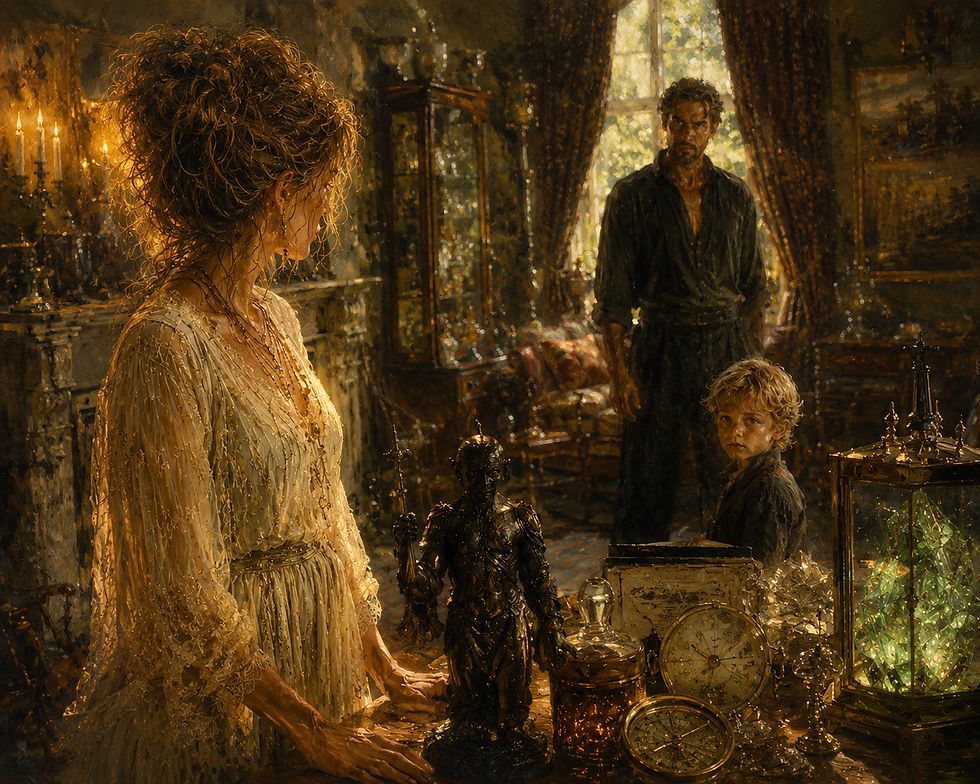
The night that finally broke her waiting began quietly.
That was always how it was with Kieran. He understood timing the way he understood everything — with predatory patience, reading the accumulated exhaustion of managing him and the boys and the house and her own fear until he found the particular thinness where she would absorb rather than resist.
Thorne had been watching him again at dinner.
That small still quality — the ancient animal watchfulness of a child who has learned that certain silences precede certain storms. Thorne was six years old and he understood things he should not have had to understand yet. She had seen Kieran notice him noticing. Had seen the calculation move behind his eyes like weather behind glass.
She did not write much about what happened that night.
Some things live in the body rather than in language. Some knowledge is carried in the hands — in the way they learn to move quickly and quietly, in the specific geography of a house memorised in the dark, in the exact weight of a child lifted without waking him.
What she would say afterward, to the woman behind the stone desk of the Ironwood Guard, sitting with her hands in her lap and her voice steady in the way that costs more than shouting, was this:
He put his hands on Thorne.
He took Wilder — an infant, unclothed, unfed — and was gone for an entire night, and she did not know where, and she did not sleep, and when he brought the baby back in the grey early morning he was calm in the way that meant he believed he had made his point.
She let him believe it.
She made her face do what it needed to do. Kept her voice at the register that meant I understand, I am not a threat to you, everything is alright. She waited until he left the house. Then she moved.
Her mother was there within the hour.
She had always been able to hear the thing underneath the thing in Evie's voice, even down a speaking stone, even at that distance. She arrived without fanfare and without questions, with the particular competence of a woman who had been waiting for this call and had already decided what she would do when it came.
They put the boys in the cart — Thorne silent and watchful, Wilder bundled against the morning cold — and drove to the Ironwood Guard before the town was fully awake.
Evie had not expected to be believed.
That was the honest truth of it. Kieran had spent months constructing his version of reality in the minds of everyone around her — patient, incremental, the particular craft of a man who understood that the most effective lies are the ones that make the listener feel perceptive for believing them. He had spoken to neighbours. He had spoken to tradespeople. He had, she suspected, spoken to at least one junior member of the Ironwood Guard, because there had been a period when her reports had been received with a careful neutrality that felt less like procedure and more like preemption.
She sat in the stone-floored office and laid out what she knew. Every fact placed precisely. Every date. Every mark. Every night.
The officer across the desk was a broad unhurried woman with flinty eyes and the attention of someone trained to hear what frightened people say around the edges of what they can bring themselves to say directly. She did not interrupt. She did not look at Evie with the expression Evie had been braced for — the faint recalibration of someone adjusting a story to fit a version they had already been given.
She listened.
She believed her.
That was the first miracle. Small and enormous simultaneously — to be believed.

The Ironwood Guard moved carefully and methodically, building their case the way careful people build things meant to last.
Kieran was served his notice on a grey morning. He was escorted from Pebblestone with the courtesy extended to dangerous men when you need them to leave without incident — firm, procedural, entirely without warmth. The door was locked behind him and the key was returned to her hand.
She stood in the front garden holding it for a long time.
The fountain trickled beside her.
The yellow vine moved softly against the stone.
She had thought she would feel more.
What she felt instead was the particular exhaustion of someone who has held something heavy for so long that the absence of it doesn't feel like relief yet. Just the strange lightness of hands that don't know what to do with themselves.
His relics remained in the shed.
She did not go near them. She closed the shed door and left them where they were and told herself she would deal with it when she had the strength. The gift of resonance made them impossible to ignore entirely — even from the house she could feel their wrongness, a low continuous pressure at the edge of her awareness like a sound just below hearing — but she had learned to live alongside worse things than that and she could manage it a little longer.
Three days after the removal, Pip appeared at the gate.
Pip worked in the administrative offices of the Ironwood Guard and was technically employed to assist with the filing. She had quick black eyes and ink-stained fingers and an absolute incapacity for discretion that Evie had always found more endearing than alarming.
"You'll want to know," Pip said, already talking before the gate was fully open.
Evie made tea. Pip didn't need tea. Pip needed an audience.
The story came out in fragments, each one slightly more extraordinary than the last. Kieran had not reported to the Ironwood Guard as instructed to begin his formal accounting. Instead he had contacted a woman — a new one, found at a coastal trading post three towns east, smooth-talked from her ordinary life with the same patient craft he had used on everyone who had ever trusted him. He had arranged passage on a vessel of extremely questionable registry. He had packed what he could carry of his stolen things and he had headed for the coast, and he had, apparently, been planning this contingency for some time.
The pirate ship — and Pip used those exact words with tremendous satisfaction — had been three hours from open water when the Elden arrived.
Evie set her mug down.
"The Elden," she said.
Pip's eyes went wide and reverent in the way of someone describing something witnessed from a very safe distance and intended to retell for the rest of their natural life. "All four of them. On the dock. You could see them from the headland — those eyes, you know how they go when they've locked onto something—"
Evie knew. Everyone knew.
The Elden were the eldest of the elven orders and their eyes were the blue of deep water and high altitude simultaneously — the particular blue of things that see through surfaces to whatever moves underneath. They did not involve themselves in ordinary matters. They did not engage with the daily machinery of removals and contested properties and the careful grinding work of the Ironwood Guard.
When the Elden came it meant something had been uncovered that went far beyond ordinary wrongness.
Kieran had apparently understood this at the precise moment he saw them on the dock.
Pip described his face with considerable relish.
Evie listened without expression.
The woman from the coastal trading post had been escorted from the vessel — shaken but unharmed, her eyes opened to certain things about the man she had been persuaded to trust. Kieran's stolen relics had been catalogued and confiscated. The vessel had been impounded. Kieran himself had been taken into Elden custody, which was a different and considerably more permanent thing than Ironwood Guard custody.
"And he won't—" Evie started.
"No," Pip said. Certain. Complete.
She left shortly after, still vibrating, already composing the next telling in her head.

The message from the head of the Elden came the following morning.
A single line, written in the spare precise hand of someone who understood that authority expressed simply carries more weight than authority explained at length.
The matter has been resolved. You will not see him again.
No elaboration. No invitation to respond.
She read it twice. Folded it carefully. Put it in the drawer alongside the other documents from those months — the evidence gathered, the statements given, the accumulated paperwork of what Kieran had tried to take and what it had cost to stop him.
They came for the relics on a Tuesday.
She did not know who they were exactly — two figures, quiet and purposeful, arriving at the gate with a cart and a list and the particular energy of people who have been looking for something for a long time and are not surprised to find it here. They belonged, she understood dimly, to the same world Kieran had operated in — the darker edges of the salvage trade, the commerce in drowned things — except that these two moved with a different quality entirely. Not the taking kind. The reclaiming kind.
They went directly to the shed without being shown.
She stood at the kitchen window with both hands around her mug and watched them work. They did not rush. They handled each object with the careful attention of people who understood exactly what they were dealing with — wrapping things properly, speaking quietly to each other in a language she didn't recognise, occasionally pausing over an item with an expression that suggested it had been missing longer than she had known Kieran.
The sick green glow she had tracked from the corner of her eye for months went out object by object.
The shed grew quieter.
When they were done one of them came to the door — tall, weathered, with the careful eyes of someone who had spent a long time in the company of things that carried old grief.
"Thank you," he said simply.
She thought about the months of their wrongness pressing against her awareness. The low continuous hum of unhappiness from the shed. The way she had closed the door and told herself she could manage it a little longer.
She nodded wordlessly.
Then they were gone.
The shed was empty.
She went and stood in the doorway for a long time, feeling the quality of the space — clean now, just timber and old tools and the particular smell of a workspace that had been waiting to be useful again. Her paintbrushes were on the bench where she had left them weeks ago, still bristle-end up in their jar. The first thing of hers she had moved into this shed, before Kieran had filled it with his darkness.
She picked them up.
Went back inside.
Pebblestone settled around her in the days that followed — not quickly, not all at once, but in the way that houses settle when something that has been wrong in them is finally gone. Gradually. Room by room. The quality of the light changed. The sounds the house made at night became ordinary sounds — timber and wind and the estuary in the distance — rather than the sounds of something alert and waiting.
She opened the windows.
She moved through the rooms without tracking the air ahead of her.
She stood at the kitchen window each morning with both hands around her mug and let the forest tell her what kind of day it intended to be.
The boys ran.
Brix patrolled the undergrowth with the self-importance of something that had always known this was its territory and was glad to finally have it confirmed.
Wilder, two months old and entirely unbothered by the dramatic circumstances of his first weeks, blinked at the light coming through the old gum tree with the focused attention of someone taking careful inventory of a world he intended to have opinions about.
Thorne sat beside her at the kitchen window one morning and leaned against her without a word.
She put her hand on his head without looking down.
Outside, the fountain trickled.
The yellow vine, three weeks in the ground, had already begun to climb.

